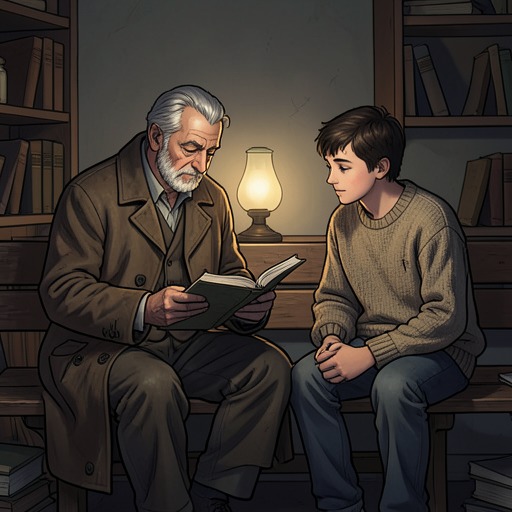
Books and imagination as a refuge
Angela's AshesBooks and imagination as a refuge is a recurring source of freedom in Frank McCourt’s childhood: reading and listening let him inhabit worlds beyond illness, poverty, and the limits imposed by adults. The refuge takes several forms—Shakespeare savored for its sound, poems exchanged across a hospital wall, books borrowed from a ward’s abandoned collection, and radio voices that open onto distant places. Its force lies not in erasing hardship, but in making a private inner life possible within it.
Shakespeare, Sound, and the Pleasure of Language
When Frank first encounters Shakespeare in a history book, he has no need to understand the lines in order to value them. He remembers the passage beginning “I do believe, induced by potent circumstances” and explains that its unfamiliar words matter less than the pleasure of saying them. The language feels like jewels in his mouth; he imagines that a whole book of Shakespeare could keep him in the hospital for a year. Reading here is both aesthetic experience and a way of measuring time: the words offer pleasure where the hospital confines him.
Patricia, in the next room, does not share his enthusiasm for Shakespeare. She says she does not know what “induced” or “potent circumstances” mean and does not care, since she has her own poetry book. She reads him “The Owl and the Pussy-cat,” whose voyage in a green boat with honey and money strikes him as nonsensical. When he says so, she threatens to stop reading. Frank replies that his Shakespeare makes no more sense to her; Seamus, who is mopping nearby, reminds them that they will have plenty to fight about when they grow up and marry. The quarrel ends in apologies and renewed reading, showing how literature becomes not only a solitary pleasure but a fragile bond that the children must negotiate together.
Their exchange turns into a clandestine routine. Patricia reads “The Highwayman” to Frank, who has to remember each verse so he can repeat it back early in the morning or late at night, when the nuns and nurses are not around. He waits for the staff to leave so he can learn another verse and discover what happens to the highwayman and the landlord’s daughter. The poem’s danger and romance hold his attention; he imagines coming by moonlight to Patricia himself, undeterred by whatever stands in the way. But the hospital’s rules interrupt the fantasy: a nurse from Kerry catches them talking between rooms, where diphtheria patients are forbidden to speak with typhoid patients, and orders Seamus to take Frank away. The exchange shows both the imaginative freedom the children make for themselves and the institutional boundary that can abruptly close it.
The Hospital Library and the Uninterrupted Inner World
The hospital’s books extend this private world beyond the poems Patricia supplies. Seamus listens as Frank describes what he is reading and dismisses the story of Mr. Ernest Bliss, a man who goes to a doctor because he has too much money and will not eat his egg, as implausible—perhaps possible in England, but not in Ireland. Frank anticipates telling his brother Malachy about the Englishman, knowing that the setting will make the absurdity believable to him. The books invite conversation and comic comparison with home, even while Frank is physically separated from it.
A girl in a blue dress brings Frank books left behind by former patients. He struggles through Tom Brown’s School-Days and laughs at the stories of P. G. Wodehouse, including Ukridge, Bertie Wooster, Jeeves, and the Mulliners. Bertie Wooster’s wealth and his daily egg-eating, for fear of what Jeeves might say, turn the earlier joke about Mr. Ernest Bliss into a recurring contrast: an egg can be an ordinary breakfast in one imagined world and a comic problem in another. Frank longs to talk about what he reads, but fears that the Kerry nurse or Sister Rita will discover the conversation and move him to the larger ward upstairs, with its fifty empty beds and imagined Famine ghosts.
Even when he cannot speak freely, Frank can continue to read, remember, and dream. At night he thinks about Tom Brown’s adventures at Rugby School and the Wodehouse characters; in his mind, the highwayman’s story remains available too. The nurses and nuns cannot prevent that inward activity. Frank recognizes the distinction plainly: the world outside can interfere with his circumstances, but it cannot command what happens inside his head. In the hospital, imagination is not a substitute for recovery or freedom of movement; it is the freedom still left to him while he waits.
Learning, Judgment, and the Mind as a Palace
Books also shape Frank’s sense of what learning is for. Hoppy O’Halloran, the headmaster, teaches history in a way that unsettles the familiar story of Irish nobility and English wrongdoing: he acknowledges that the Irish committed atrocities at the Battle of Kinsale, including killing prisoners, and insists that they were no better or worse than the English. Frank sees the significance of this challenge because it disrupts the history he has been told. O’Halloran urges the boys to study before making up their minds, describing the mind as a house of treasure that should not be filled with rubbish from the cinemas. Even a boy with broken shoes, he says, can possess a palace in his mind.
The lesson is not merely abstract. O’Halloran inspects the boys’ footwear, calls their broken or absent shoes a disgrace, and organizes a school boot-fund raffle. Frank and Malachy sell tickets across Limerick; eleven boys without boots receive new ones, while the brothers receive none because they have shoes, worn soles notwithstanding. The episode places intellectual dignity beside material deprivation without confusing the two: the headmaster addresses the immediate need for warm boots, while his image of the mind insists that poverty does not exhaust a person’s resources.
Frank’s father offers another account of learning during the early mornings when they are alone by the fire. He makes tea, lights the fire, and reads the Irish Press or talks to Frank about world affairs. Against the father’s recurring drunkenness and the family’s need for relief, these mornings are a distinct, intimate interval: he tells Frank about hedge schools, where Catholic children learned English, Irish, Latin, and Greek when the English would not allow them ordinary schools. The masters risked being transported if caught teaching, yet people gathered in ditches to hear them and wondered at how much a person could carry in the mind. The father connects this history to Frank’s schooling now and urges him to study so that he can return to America for an indoor job, warm clothes, and a place out of the rain. Learning becomes a practical promise as well as a cherished inheritance.
Radio and the Expansion of the World
Later, Frank’s access to stories widens through the wireless belonging to Mrs. Purcell, his grandmother’s next-door neighbor. Because she is old and blind, the government has provided the lane’s only radio. Frank wants one too, and on Sunday nights he sits on the pavement outside her window listening to plays on the BBC and Radio Éireann. He hears works by O’Casey, Shaw, Ibsen, and Shakespeare. Shakespeare remains inexhaustible to him—like mashed potatoes, he says, one can never get enough—and even the strange Greek tragedies, with their stories of people who blind themselves after marrying their mothers by mistake, enlarge the range of lives a story can contain.
One night, while Frank listens to Macbeth, Mrs. Purcell’s daughter Kathleen invites him inside because sitting on the ground in the weather might give him consumption. He receives tea and a large slice of bread spread with blackberry jam, then tells Mrs. Purcell that he loves Shakespeare. She, too, values the plays as music and stories, and says Sunday nights would be empty without them. The scene turns listening into hospitality: the radio brings Frank to the window, but the shared love of Shakespeare brings him into the house.
After the play, Mrs. Purcell lets Frank turn the radio dial. On shortwave he hears whispering and static, the sea-like whoosh of the signal, Morse code, instruments, and voices from far away. Those sounds set off a vivid imaginative journey: Frank pictures sailors, cathedrals and skyscrapers, cottages, the Sahara, the French Foreign Legion, cowboys on the American prairie, and shepherds on the Greek coast. The journey moves from distant landscapes to cafés, boulevards, doorways, and monasteries, before Big Ben and the BBC Overseas Service bring him back to the news. Mrs. Purcell asks him to leave the broadcast on so they can know the state of the world. For Frank, the shortwave is at once sound and spectacle: a poor boy sitting outside a neighbor’s window can make the whole world present to the imagination.
A Refuge That Poverty Cannot Close
Across these episodes, books and broadcasts answer different forms of confinement. In hospital, memorized poems evade rules against talking; borrowed novels occupy long days and nights; history challenges inherited assumptions; and the radio opens a path from a pavement in Limerick to distant landscapes and voices. The refuge is not sealed off from material circumstances: Frank worries about illness, empty beds, broken shoes, and the rain, while stories repeatedly bring him back to those conditions. What they provide is room within them—to learn, to picture elsewhere, to argue over poetry, and to share a world with another listener.
The recurring image of the mind as a palace gathers these experiences into more than a defense of reading for pleasure. O’Halloran’s lesson and Frank’s father’s memories of hedge schools make knowledge a form of dignity that poverty cannot simply confiscate. The hospital gives that idea an immediate shape: staff can separate children by illness and restrict speech, but they cannot stop Frank from remembering a verse, following a story, or imagining beyond the ward. The inward life is not a magical escape from hardship; it is a space in which hardship does not get the last word.